The Bazaar #95: Core Rules System Chapter #4

Updated: May 13
(Skill Selection)

GENERAL
The Core Rules System is my attempt to present a holistic system of rules that could be applied across all the Palladium Books RPGs. This is a baseline, breaking down the core principles of the games, at each stage, and taking any minor variances from each game into account by softening the edges and dovetailing pieces together.
Reaction from the first three posts has been wildly positive, which demonstrates proof positive of several things. Whether or not I’m hitting ‘the mark’ with readers by way of the suggested changes in the CRS, or just the very idea of proposed updates and holistic compilations to the core Palladium Books rules may well be a perfectly valid solution space as well. If this serves as a market bench mark, let it be as much, and I hope Palladium Books takes it for the intent it provides.
CHAPTER 4 – SELECT SKILLS

General. This is an expansive chapter, in that it does a lot of things on very few pages. The Chapter itself is ONLY three (3) pages long. For the most part, it simply takes things we all likely know or take for take for granted and codifies things into a single source. These three pages then leads into the Skills List; that is, the universal skills list. That is ONE list, applied across all games. It works, and it works using the very rules already in place that perhaps GMs have forgotten about, or never thought to apply. I’ve also added a few things I thought would round out some gaps I identified; nothing ground-breaking. So, let’s take look!
Skill Rationalization. This was a bit of a doozy, and some readers may take a bit of time to realize how much better off things could be. Based on the great work of Mellow Maverick, who took the time to transpose EVERY skill from EVERY book published across EVERY Palladium Books RPG, the total number of skills came out to a whopping and quite frankly ridiculous 857 skills, over 26 categories. In that series of groupings, there is a smorgasbord of duplication, many of which did not match in terms of description, Base Skill, Skill Category, and a multitude of skills that are too far into the weeds or simply just a specialization of what I would consider a “Parent Skill.” Translation: a lot of rearrangement and cutting to clean stuff up. Where applicable categories are dropped, skills nested into an applicable Category. For RPGs where Skill Programs are used (e.g. HU2, N&SS), care will be provided to ensure the Categories remain as close as possible to the originals. A short list of examples:
Paranormal Skills (Category) from BtS moved into Science (one), Technical (all those Lore skills….) and Rogue (one)
Transportation (Category) from BtS renamed/folded into Pilot (Category)
Qi Game Skills (Category) from Ninjas & Superspies moved as Specialization of Gaming Skill
Computer (Package) from Ninjas & Superspies moved to Technical as this only really affects Secondary Skill selection; no impact to Skill Programs.
Cowboy (Category) from Rifts World Book 14: New West is redacted and the skills moved to more appropriate categories.
Pilot Advanced (Category) from Ninjas & Superspies becomes entirely irrelevant with the Specialization schema and re-organization of the skills therein. Restrictions from Skills programs or Secondary Skills from choosing Combat Flying, Pilot: Helicopter and Pilot Jet Aircraft and it's all tied off.
Espionage, Military, and Rogue Categories. Over the years, these three have morphed to effectively picked up scads of skills from the others. General clean-up to keep one copy nested in the most appropriate spot. Conversion Notes to clean Class skill selections.
Lore and Language Skills. Base skill mentioned only, with the GM and Players referred to respective Conversion Notes for applicable lists. Why do it this way? Well, bloat for starters (e.g. ~60 Lore entries, over 35 Language entries). Primarily though, that's the list your PCs should be limited to because that's the system they were created to play in. If your PCs galavant over to other settings, the GM can make those skill available as required or as they see fit.
Hand-to-Hand Skills. Well, let's just say they'll be covered in Chapter 7 - Combat. The current format and philosophy for these skills leave a little to be desired..... <wink-wink, nudge-nudge>
Second Order Impacts. One of the first things that needs to be addressed is the impact of folding away certain Skill Categories will have on certain Classes. Aside from updating (super) old Classes, this is one of the primary reasons for Conversion Notes. The essence of each class remains unchanged, the skills each have remain unwavering, simply where some are nested gets updated (e.g. Computer Operations in Technical instead of the Computer Category). Conversion Notes will present updated impacts to Skills on Classes, and also present some of the RPG-specific skills that may not be listed within the Baseline list (e.g. the COPIOUS of RPG-specific language or lore skills).
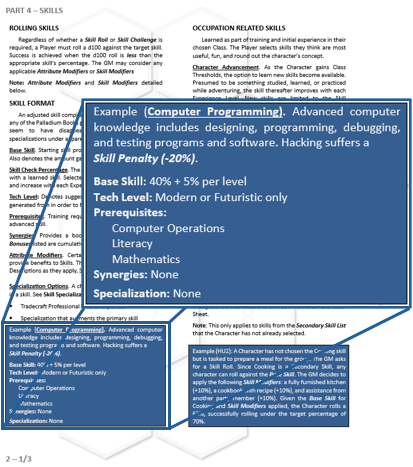
Skills Format. Largely unchanged. As you can see by the example skill provided in the image, it’s almost exactly like every skill you would find in any Palladium Book RPG, with a few tweaks:
Base Skill: No change
Tech Level: Referring back to Chapter 1; describes limits to which Dimension Tech Level is required to learn the Skill
Prerequisites: Pulled out of the narrative text
Synergies: Pulled out of the narrative text
Attribute Modifiers: Specified Attributes and bonuses provided
Specialization Options: Specifies the various options available
Note on Restrictions: Skills are also listed with Restrictions (e.g. Pilot: Spacecraft: General has ‘Restricted: Outer Space’). Just because Rifts is a Futuristic Tech setting, a PC from planet-side likely has no possibility of learning this skill; at least not initially. This isn’t hard and fast. A GM can always open this up if they bring the PCs to Phase World, somehow get them into the Mutants in Orbit setting, or give them some other viable reason or opportunity to learn the skill. They are primarily meant for Character Generation guidelines and suggestions for the GM.
Attribute Modifiers. There is something to be said for Player Characters leveraging something other than the two or three "god-stats" of Palladium Books RPGs. Maximizing Physical Prowess (PP) for combat for all PCs, Intelligence Quotient (IQ) for skill monkeys, and either ME for psionics or PE for mages to max out their ISP or PPE respectively makes the other stats complete after-thoughts. Looking at several skills, this really shouldn’t be the case. So let’s leverage that!

Specialization Options. Something that is already there in the rules but not really codified. This aspect also opens things up for GMs to explore the Skill Table and develop their own table’s brand of skills. The table presented below is the baseline. It is representative of the Skills that are transferable across ALL of the Palladium Books RPGs, within the Restrictions noted above. There are two options:
Tradecraft Professional. Basically, just your PC that takes a skill multiple times to gain greater proficiency. The classic example is the Cook skill provided below.

Any Tradecraft Professional selection provides a cumulative Skill Bonus (+10%) to the Base Skill.
Specialization. This is where we find most of the skills you might be hunting for from the initial Skill Table. Largely high-level education requirements, these are basically collected under the ‘Parent Prerequisite’ skill. This is also the mechanism that provides the GM option space to develop their own series of Specializations as they see fit.
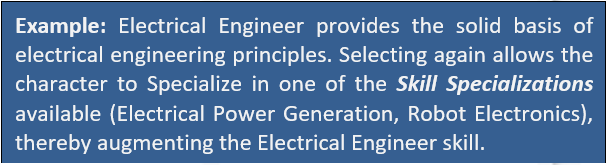
Any Specialization selected provides a cumulative Skill Bonus (+10%) to the Base Skill.
Attempts to use the Base Skill in a field of study without the Specialization incurs a Skill Penalty (-20%).
Note for GMs: This is where GMs can really just go to town and personalize things if they like. The classic example online is the Pilot: Automobile skill, which is often glossed over to mean EVERY car (e.g. automatic, manual transmission, NASCAR). Now, a GM could simply apply the most common type to the baseline skill and apply a Skill Penalty (-10% to -30%) to an unfamiliar type. I’ve seen some hilarious real-life failures at using a stick-shift. In the CRS, a GM could apply the Baseline skill to mean Pilot: Automobile (Automatic) and require Specialization for other discrete car types (e.g. Manual, Limousine, NASCAR, F1 Racer). This could be extended to any other Skill, though I would caution against getting too granular as to limit the freedom of PCs to select a variety of usable skills.
Skill Modifiers. No great change here, other than greatly reducing the extraneous text and improving the table to better reflect all the Skill Penalties AND Skill Bonuses to apply to Skill Checks. All in one table; makes a great add for a GM screen.
Skill Challenges. Something I found that came up every so often was the interaction of a PC and NPC with two skills that directly oppose or interact with the other. How does a GM work their way through deciding who wins? Well, there’s a heuristic for that. Basically, the four possibilities are laid out with clear results for a GM to consider, then quickly jump back into the action without spending too much time hammering out the mechanics. So now if the PCs are trying to sneak-and-peak (Prowl) while a guard is on watch (Perception), the GM has a simple solution space. Easy-peasy, right?

Perception Rolls. There are a generous number of times the use of Perception Rolls that are used to challenge Skill Rolls. Generally, it also never applies directly within the Combat rules, so I decided to pull the rolls into the d100 space and make it a skill-equivalent Roll. As demonstrated, I use a method that allows Skill Modifiers to apply directly to a Base Perception. This method for Perception always seemed more intuitively matched to the Palladium Books d100 side of the rules; the d20 has always been the "combat side" and when it came out, just seemed like a knee-jerk adaptation of the popular d20 system rules at that time.
Pressured Skill Check. Something else that already exists in the rules, but isn’t really brought to the fore. Essentially this is a pressure valve that the GM has to present a more stressful series of rolls, something that allows a more prolong narrative element to the adventure that might need more than a single skill roll.

Skill Table. The final Skill Table is a little deceptive. There are a fair number of skills on this table, but a fair number more remain unlisted; they are Tradecraft or Specialization options. As a baseline, it takes a list of 867 skills across 26 categories and flattens the choices in a manner that makes things manageable to dovetail from one RPG to the next. All the percentages are the same regardless of RPG, relying on the Skill Bonus/Penalty table to apply for those leaving their home RPG into another.
Secondary Skills. Lastly but certainly not least, you’ll note that all the Secondary Skills are noted across the table for ease of identification. This is to allow both Players and the GM to quickly scan for and identify a Secondary Skill that may be applicable to the adventure sequence at hand. In the CRS, all PCs can roll against an eligible Secondary Skills (Tech Level dependent). The roll is limited to the Base Level percentage. The PC can apply any Attribute Bonus, and the GM can then apply any Skill Bonus/Skill Penalty (typically a Skill Penalty) they see fit as well. This allows PCs to use ‘common skills’ more generally known or picked up through life, could at least attempted, providing a more common-sense solution option for the GM. Remember though, just because it’s listed as an option doesn’t mean the GM has to allow it.
CONCLUSION
So, by updating the Skills chapter, we see one of two substantive changes, and surprisingly mostly due to secondary effects. The reformatting of the particular skill template really just cleans up the presentation and makes things easier to read and skim through; no big deal. The codification of the Tradecraft and Specialization, something that already exists, should be a relatively benign experience. How to roll a skill seems like a motherhood statement, but I guess was never really specified. Pressure Skill Checks are also already in there as well, perhaps not to the point that some may recognize.
I’m sure some readers take umbrage with parts of what’s proposed. The idea of bringing Perception checks into the d100 realm; Secondary Skills as baseline use by all PCs; Skill Challenges and their mechanics; the choice of skills that were dropped in the skill rationalization process. To call it what it is though, if we’re going to have any kind of success with a new, updated version of a Core Rules Set, the current Skills library needs to get refreshed and updated. This does impact Classes across most of the RPGs; Class Skills, Other/Secondary Skills, Skill Categories, and Skill Programs need some tweaking. This was the first of two major reasons for the Conversion Notes files I started compiling to update the Classes for the various RPGs.
Chapter 4 – Skills required a fair bit of work to baseline the various (copious) repetitions, variations of skills and skills categories across all the different RPGs. Change or rip out too much here and it makes something unworkable in a Class, or a Skill Selection schema is unworkable. Despite all these issues, and with the help of Mellow Maverick, I was able to whittle down a gargantuan pile of skills and develop a heuristic that I believe works across all the Palladium Books RPGs. This was an iterative process, and I did go back at least once or twice and realize I had "buried" a skill as a Specialization in error, or forgot to include som Tradecraft options. The result firmly upholds the tenets of the CRS project, while still allowing GMs the flexibility to get further into the weeds as they like at their own tables.
So there we have it, the update to Chapter 4, or at least how I would propose it under the CRS. Will it be everyone's cup of tea? I don't purport to try to please everyone. I will stake the claim that the CRS goes (forgive the humility) a giant leap in the right direction to getting the Skills portion of the rules set to work across all the Palladium Books RPGs. So, what say you?
Return to All Posts
Please LIKE and SUBSCRIBE!


Comments