The Bazaar #101: Core Rules System Chapter #7

(COMBAT RULES)

GENERAL
For many in the Palladium community, the idea of a central, unified rules system is something of a holy grail. The possibility of a Game Master able to take Player Characters from any one particular setting and then cross-over or merge them with another seems like an ever-elusive goal; the veritable pot of gold at the end of the rainbow. It certainly seems like it should be a feasible thing. Most PB RPGs work off the same basic premise: d20 for the action and most saving throws, d100 for the skill checks and few other cases.
Thus far the reception to the CRS Project has been a resoundingly positive one. I’ve had dozens of requests for the entirety to be posted in PDF format, which certainly speaks to the market desire for a more unified, baselined rule set. Whether or not the CRS Project, with its particular idiosyncrasies that I’ve added in are the cup of tea that GMs and Players are looking for is a separate issue. One this that I can attest to is the no-charge market research advice this would be for the folks at Palladium Books – the demand is there.
So here is on GM’s version of what it might start to look like.
DISCUSSION
General. So, we’ve completed the first six chapters and covered a lot of ground. This next one, however, is the one that will generate the most discussion, dare I say the most debate and controversy. Chapter 7 – Combat is also the engine that delivers the GM a framework for how to conduct the kinetic action for the game. As most Players looking into any RPG, the combat section is largely the heart of the game, or at least one of the key components that drives how they interpret the success of that particular gaming experience.
Backward Compatibility. Regardless of what you think of the presentation, CRS strives to remain both 100% backwards compatible and RPG agnostic. I’ve largely just codified rules from multiple sources, or presented them in tabular form instead of paragraph format (e.g. Resistance and Vulnerability, Action and Action Challenges). In others, I’ve made changes I would openly and strongly suggest to Sean and Kevin (e.g. rework the various baseline Hand to Hand options, use of tables and keywords).
Megaversal Rules. Dragging the following in from a previous post because it remains topical.
“I don’t claim any ownership, but if Palladium Books wants their games to be truly compatible, a somewhat significant reset is needed for to attract a new generation of Players and Game Masters. This really is the ultimate aim for this project. I want Sean and Kevin to launch something that captivates the current market with the incredible game systems and lore they’ve developed, with a single, cohesive rules system.
“Currently, things are a hodge-podge of rulings and commentary across a dozen books, more of them NOT the respective core game RPG books. If Palladium Books wishes to continue to purport their games as such, there needs to be a clean way to dovetail from one to the next.”
CHAPTER 7 – COMBAT
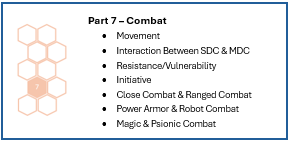
General. This is a doozy of a chapter, and one I’ve debated about splitting into two posts. Not just because it comes in at a whopping total of twenty-four pages (24)! Only Chapter 4 – Select Skills comes in any chunkier, and that’s because of the Skills Library, which totals 44 pages. But just like Chapter 4 – Select Skills, Chapter 7 – Combat serves to provide the second side of the coin that GMs will leverage for the majority of their campaigns and has come to define the Megaversal System: Skills rolled on their d100 framework, Combat rolled on their d20 framework.
Keywords. Likely one of things I forecast will cause the most grumbling. Concurrently, it is also the one thing about Palladium Books’ rules that is the most debated and argued. There are myriad examples of Palladium Books RPG rules left to the GM for interpretation; and to be honest, until revising the whole lot writ-large, this will remain the case. The issue is that the rules set across all the RPGs were a little fractured and needed to be collated and brought into a holistic, unified whole. Chapter 7 - Combat is where we really start to see the Keywords take effect; essentially a scaffolding that provides the necessary bulwarks to keep the rules clean and easy to understand. They also allow the clean crossover from one setting; no fuss, no muss. For the most part, absolutely nothing new; it’s just a pivot to what veteran GM/Players already know, and will be provided in fulsome at Chapter 10 – Glossary. Some examples:
Strike becomes Action: Strike
Dodge becomes Action Challenge: Dodge
Saving Throws become Action Challenges (e.g. Action Challenge: Save vs Magic)
Dice Roll becomes Natural Dice Roll
Roll plus Bonuses/Penalties becomes Total Dice Roll
Loss of 2 Actions becomes Action Penalty (2 Actions)
Chapter Framework. One of the first things done was to codify the various sections of Combat, which allows us to nest certain discrete definitions or keywords to those parts of combat. There should no longer be any confusion about the validity of adding the Attribute Bonus (PP) to a certain type of Strike; it’s been defined. Limitations are presented in black and white. In order to keep things differentiated, I broke things down as follows:
Megaversal Combat (General)
Section 1 – Close Combat
Section 2 – Ranged Combat
Section 3 – Power Armor and Robot Combat
Section 4 – Land Vehicle Combat
Section 5 – Aerial Vehicle Combat
Section 6 – Spaceship Combat Rules
Section 7 – Magic in Combat
Section 8 – Psionics in Combat
MEGAVERSAL COMBAT
Movement. Largely drawn from the TMNT Redux books, its clarifies what was laid down.
Structural Damage Capacity (SDC). Quickly defined.
Armor Rating (AR)
o Attacker’s Total Dice Roll need to “meet or beat” the AR
o Hits below the AR, Defender gains Resistance (1)
o MD weapons ignore AR (no change)
SDC Weapons. Defined and examples provided.
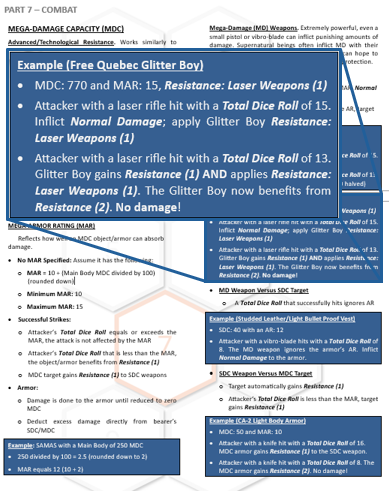
Mega-Damage Capacity (MDC). Quickly defined.
MDC = SDC x 10
MDC gets from Mega-Armor Rating (MAR)
Mega-Armor Rating (MAR)
o MAR = 10 + (Main Body / 100) rounded down
o Minimum MAR: 10 // Maximum MAR: 15
o Attacker Total Dice Roll need to “meet or beat” the MAR
o Hits below the MAR, Defender gains Resistance (1)
SDC/MD Weapons and MDC. Defined and examples provided to also demonstrate how SDC weapons can possibly damage MDC targets (with great difficulty).
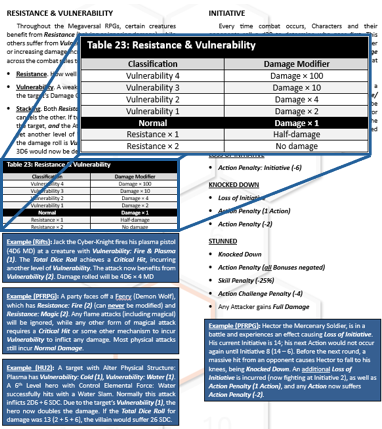
Resistance & Vulnerability. Something that already exists in the game (e.g. Critical Hit = Damage x 2, certain things halve-damage). Once I applied MDC = SDC x 10, I injected some higher levels of variance. We’re all comfortable with Critical Hits doubling damage, but nothing was devised for GMs to handle what to do if you Critical Hit a creature with “Vulnerability to fire” with a “fire” weapon. Well, this table helps out. While it provides some measure for SDC weapons to have "an effect" on MDC targets by leveraging the Vulnerability side of the table, it also provides MDC targets a quick and easy way to defer damage. This heavily favours the MDC side of the equation, which reinforces the immersive idea that High Technology fabrication can produce materials that are more highly resistant to damage.
Initiative. There is the unfortunate effect of Rules as Written with Initiative that could place multiple Players and NPCs with a Loss of Initiative that effectively stacks them all at Initiative 0. Add to this Knocked Down and Stunned seemed to interact with each other but not formally so, I decided to group them together and worked from there. They now interact as discrete penalties (e.g. "-6 to Initiative" as opposed to "loss 50% from Initiative") as the latter oddly enough functionally doesn't work the same on a Juicer as it would on a Vagabond. Taking it one step further, they each function on an escalatory scale, but the penalties also stack one atop the other.
Loss of Initiative (first level of effect)
Knocked Down (second level of effect)
Stunned (third level of effect)
So while getting hit with a Loss of Initiative is bad enough, a PC then suffering from a Knocked Down effect adds those negatives to the ones already suffered from the Loss of Initiative. So while a PC could suffer a Loss of Initiative, then get Knocked Down, then Stunned, and the negatives from each effect stack on top of each other, which is bad-news-bears for any PC, the Players are also eligible to incur those penalties on their targets as well.
SECTION 1 – CLOSE COMBAT RULES
Steps of Close Combat. Remain largely unchanged, less the Keywords (e.g. Strike becomes Close Combat Strike) and presenting the Action and Action Challenge options in point form, with a few nuanced changes to Action Challenge: Entangle and Action Challenge: Parry, where some risk comes with reward or massive penalty.
Hand-to-Hand Skills. Something I know is going to ruffle up some feathers. The current tables of the Hand-to-Hand forms provides a list of bonuses per Experience Level. If you were to tally all those bonuses side-by-each, there is fairly limited differentiation. I propose recreating the tables so they mesh with Threshold advancement (i.e. when Classes get other skills, other Class abilities), and reshaping the six primary Combat types into more discrete forms of benefits and bonuses. This makes them more of a choice to the Player, as opposed to just hunting for the table providing the best bonuses to Close Combat.
No Hand-to-Hand Combat. Civilian with no formalized training.
Hand-to-Hand Basic. Your basic moves and ability to react without taking too much damage (e.g. Guards/Police/Basic military).
Hand-to-Hand Expert. Advanced, well-rounded training with a concentration on Holds (e.g. SWAT/MMA/Elite military).
Hand-to-Hand Martial. A mélange of forms concentrating on agility, defense, and counter-strikes.
Hand-to-Hand Assassin. A specialist series of training mostly to augment precision and killing power.
Hand-to-Hand Commando. A military form that practitioners take to maximize overpowering their targets and maximizing damage output over defense.
Close Combat Actions. We still have the list of actions, just reformatted with Keywords and presented in point form phrases. Quick and easy reference.
SECTION 2 – RANGED COMBAT RULES
Steps of Ranged Combat. Remain largely unchanged, less the Keywords (e.g. Strike becomes Ranged Combat Strike) and presenting the Action and Action Challenge options in point form, with a few nuanced changes to Action Challenge: Parry.
Ranged Combat Actions. Long-story short, you need a Weapon Proficiency or you are limited to firing Wild Shots; no Attribute Bonus (PP), No Hand-to-Hand Combat Bonuses (because they apply only to Close Combat Actions – gasp!).
Other. Some other variances included specific rules designed for:
Sniper skill
Sniper-style Weapons
Immobile Targets
Blinded Targets
Targets in Cover (e.g. smoke, trench)
Missiles. For missile combat, things get better defined (e.g. guided missiles), and Keywords now apply an actual rules differentiation to the various missile types.
SECTION 3 – POWER ARMOR/ROBOT COMBAT
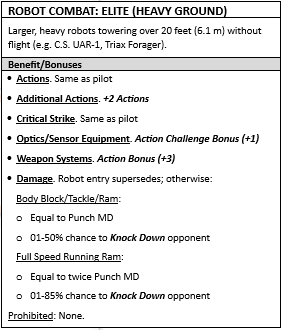
General. Basically, each of the following gets a small table that specifies the Action / Action Challenge bonuses applicable while piloting the specific variance of power armor or robot (or mecha), as well as specific combat moves and their effects:
Power Armor Combat (Basic)
Power Armor Combat Elite (Flying)
Power Armor Combat Elite (Ground)
Robot Combat (Basic)
Robot Combat Elite (Flying)
Robot Combat Elite (Ground Vehicle)
Robot Combat Elite (Light Ground)
Robot Combat Elite (Heavy Ground)
SECTION 4 – LAND VEHICLES COMBAT
Vehicle Control Rules. Some reshaping of tables to make things more malleable to the Action/Action Challenge framework, particularly the Speed Modifier Table, as the Speed Class directly impacts as a Natural Dice Roll Penalty for any Ranged Actions.
Combat Driving. A table for the Combat Driving skill that provides a pilot some similar bonuses to driving a land vehicle that a pilot of a power armor/robot might experience.
Vehicle Combat Manoeuvres. A list of specific Actions / Action Challenges for Land Vehicle combat.
SECTION 5 – AERIAL COMBAT
General. A lot of what you saw in Section 4, this time applied to jet aircraft, helicopters, space fighters, Sky Cycles, and the like (e.g. could be extended to mounted dragon duels, or pegasus combat).
Combat Flying. A table for the Combat Flying skill that provides a pilot some similar bonuses when flying an aerial vehicle to that of a power armor/robot.
Vehicle Combat Manoeuvres. A list of specific Actions / Action Challenges for Aerial Vehicle combat.
SECTION 6 – SPACE COMBAT
General. You wanted rules for capital ships and space frigates? We got rules for capital ships and space frigates; missile volleys, variable force fields and all that.
Combat Flying. A table for the Combat Flying skill that provides a pilot some similar bonuses when flying an aerial vehicle to that of a power armor/robot.
Vehicle Combat Manoeuvres. A list of specific Actions / Action Challenges for Aerial Vehicle combat.
SECTION 7 –
MAGIC IN COMBAT
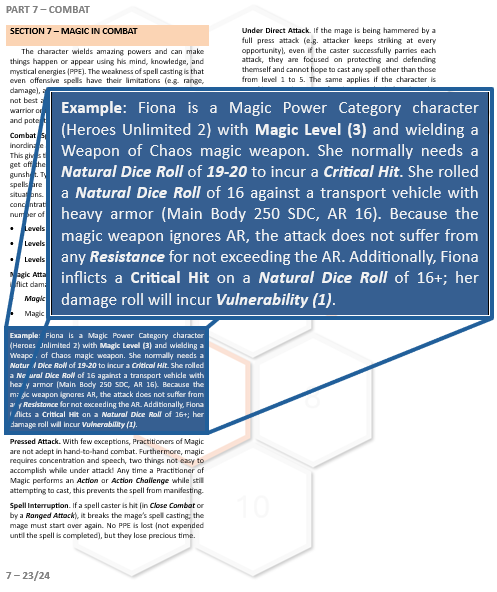
General. A lot of this ties back to Chapter 5 – Magic, but specifically it details the problems Practitioners of Magic must overcome in combat settings, be it Close Combat or Ranged Attacks.
SECTION 8 –PSIONICS IN COMBAT
General. A lot of this ties back to Chapter 6 – Psionics, but specifically it details the what Psionic Characters must overcome in combat settings to leverage their psionic powers, be it Close Combat or Ranged Attacks.
CONCLUSION
For the majority of the retrofit to the Combat rules involved clarification, syntax clean-up, and application of Keywords. Most everything found within the 24 pages of Chapter 7 – Combat was collected from across the various Palladium Books RPGs, baselined to be a one-stop shop of rules that allows GMs and Players a single source reference. One of the crucial frustrations has always been searching for a rule or a part of the system and the GM having to conjure up something on the fly or cobble together something, only to learn there were already rules found elsewhere in a separate RPG.
Let’s not gloss over the suggested change to MDC and SDC. The fact is, MDC at SDC x 100 causes several unintended consequences. Simply changing to SDC x 10 and being eligible to damage by SDC weapons swings the pendulum too far. The advent of the Mega-Armor Rating (MAR), application of the Resistance/Vulnerability table (and nuance for Magic and Psionics) makes for a more complex but intuitive approach to the combat scenario.
The few more impactful changes I made involved the reworking of the Close Combat tables in order to differentiate them from one another. This will certainly cause some consternation with the veteran Players, and quite frankly that’s fair. I’ll stand on that hill. The six tables are mostly just a jumble of random bonuses, and some of them don’t even clearly understand what they’re supposed to be doing. I just propose they be clear-cut in their differences, the more advanced versions limited in selection based on the Player Character’s Role, certain Roles paying much higher “Skill tax” for anything outside of Hand-to-Hand: Basic.
Lastly, the advent of Keywords. These provide the scaffolding needed to the rules, ensuring that both Players and the GM understand exactly what is being asked for. It’s mostly for the GM, but helps clarify things for Players as well. There are already a series of definitions within most of the Palladium RPGs, but you’ll note that not all of them line up. Like it or not, these variances between one RPG to the next strikes a dagger into the heart of the claim of a “universal system.” If it works in a certain manner in one RPG, it should work the same in another, particularly in light of several RPGs that actively reinforce the possibility of moving from one to another.
As the engine that drives the dynamic aspect of the game, this Chapter sees a lot of things revised and boiled down to the basics, presented in as simple a manner possible. The use of Keywords allows a lot of unspoken text to be implied, tables packing a lot of information in a small amount of space.
Return to All Posts
Please LIKE and SUBSCRIBE!


Comments