Scholar’s Review #86: Dimension Book 4: Skraypers


Written by: Kevin Siembieda & John Zeleznik
Release Date: May 1998
GENERAL
After the success of Dimension Book 1 revealing the dark battle pitched across Wormwood, and the expansive space opera setting of Phase World in Dimension Books 2 and 3, we dive into a very discrete setting. Much more like DB1: Wormwood, Skraypers provides GMs and Players with a sandbox for their adventures, with a fantastic array of adventure possibilities, and methods to merge from across the Palladium Books RPG lines.
The story is of a solar system at war, as one planet’s race (the Tarlok) goes about exporting their planet’s primary commodity, warfare, and subjugating the other planets in their system. This warlike, reptilian species is monstrous in more ways that just their appearances. They use genetic warfare as a precursor to attack, enslave the populations they invade, and consort with the villainous and worst sorts of the Corkscrew galaxy. Let’s explore the first attempt at a real cross-over book!

SECTIONS
Building Worlds. A few words from Kevin Siembieda on the overall project, including some of the re-write process. As this is a setting that conjoins the mechanics of superheroes from the Heroes Unlimited RPG (and its SDC settings) and the Rifts RPG (with an MDC base), it is somewhat serendipitous that I started doing this review during the releases of the Core Rules System. In those posts, I speak to some of the problems of trying to merge an SDC and MDC setting; perhaps that speaks to some of the issues Kevin implies.
Some Words from John. I’m glad John had a chance to provide some words as well.
The Tarlok Invaders. We got through a series of world building entries to give the reader a bit of context and background. Ancient history depicts mythology of a race known as the Lonara that conquered the Tarlok for thousands of years. A variant of the dinosaur-like races (akin to velociraptors) began banding together and sweeping across the planet, not unlike Mongolian cavalry did to the Romans. The Lonara and their Tarlok slaves grew in power as they defended themselves. The Tarlok, under Lonara mentorship, developed their own society and grew both in stature and technology. Over the centuries, the Tarlok’s martial society took root, while the Lonara died off, the last seen centuries ago. We go through a few entries about the warrior culture and the military hierarchy and economics.
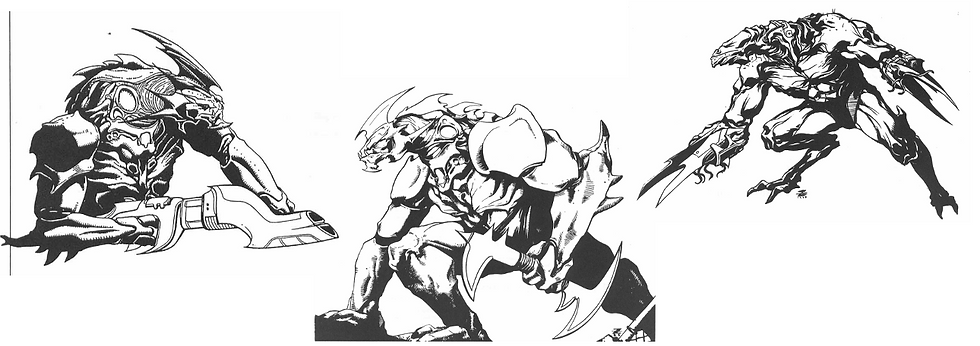
Tarlok Warrior RCC. Eons of fighting have developed these beasts for combat. Boasts natural body armor, two hearts for increased healing and a raft of increased Attributes. Provides an entry that allows for both an SDC or MDC campaign setting.
Tarbull RCC. Powerful, elite infantry that are dogmatically attached to the warrior culture to the point of extremes. Basically your Tarlok Marines with some heavy Attribute Bonuses and not insignificant psychic abilities on top of it all.
Shertar. More civilized and educated, not well received among the majority of Tarlok society. Control their aggression to gain scientific knowledge doesn’t mean they aren’t fanatically loyal or just as driven. Much less combat oriented (duh).
Teklok Cyborg. Take a Tarlok and perform a limited cyborg conversion; limited to get them back into combat. Volunteers typically handle the shock better, but whether rebuilt from near-death or by choice, they are potent machines of war.
Dreadlords. It took five centuries of effort to produce these genetically modified covert operatives (mostly Shertar). Basically put into a cocoon and reprogrammed, they are reborn as killing machines; comes with a price.
Dreadmasters. Your basic Tarlok lucky enough to be born with psychic gifts. They are tailored to become the masters and ‘quasi parents’ to their Dreadlord charges, forming a bond that makes them a truly deadly team.
Charizolon System. Oddly, we only now start with the description of the planetary system where all the action takes place. We get a synopsis of the planets, including the following planets and moons of note with inhabitants:
Charizol. The system’s star.
Vuulok. Planet of the Tarlok.
Razuul (Moon of Forscell). Inhabited by a slave race (the Glinerach), used as psionic interrogators and spies by the Tarlok. Note: Includes the Glinerach RCC
Razuul (Moon of Forscell). Eons ago the monstrous predators of Forscell (the Nazeer) were slaughtered when the Tarlok first arrived and conquered the moon. They now willingly serve as warrior-slaves. Note: Includes the Nazeer RCC

Avulor. An aquatic planet with an enigmatic aquatic race (the Cyden) that have a non-aggression/compliance pact with the Tarlok. It took the Tarlok 75 years to even notice them. Note: Includes the Cyden RCC
Talavera. Moderately advanced jungle world with three races that made contact with Seeron prior to the Tarlok’s arrival. When the Tarlok arrived, the native inhabitants had had suffered mysterious losses of over 50% of their people. Note: Includes the Seleniak, Lashreg and Shrilt RCCs

Dilm. Giant mountain ranges, deep canyons with sparse vegetation across the plateaus. Note: Includes the winged reptilian Klied and winged monstrosity Nikari RCCs
Seeron. Planet where the majority of the action is intended to be depicted. Home to Humans, Seerman, Talus and Bio-Freaks, depicted in more detail later on.

Beyond Charizon. Located in the Corkscsrew Galaxy, the Tarlok have begun to reach out and make contact with being and species from other systems.
Blhaze. Alien beings of energy and mega-heroes, they are highly intelligent and powerful thorns against the Tarlok’s tyrannical methods. Regardless of SDC (HU2) or MDC (Rifts) setting, these beings are very powerful indeed. Depicted in purple on the cover.
Rithe. Powerful psionic creatures, they have a trade pact with the Tarlok. They are immensely interested in the superbeings of Seeron, and are considering trading their interstellar engine technology to get more of these beings.
Tandori. Allies of convenience, neither they nor the Tarlok care for each other, but they each are conquering races that deal in the slave trade. Technologically advanced.

The Story of Seeron. An overview of the Tarlok invasion, including the barbarism that sets them up as the “bad guys” for a variety of reasons that really need little explanation here. Needless to say, any hero/anti-hero will have little neeed for motivation to fight against the Tarlok and their allies, in particular the Bureau of Control and Registration (aka “Control”). As per their way, Seeron was targeted with the virus that decimated Talavera, but early exposure and Seeron’s attempt to help the Seleniak developed a natural resistance to the weapon; the result actually triggered the very superbeings and response mechanisms that the Seeron people are leveraging against the Tarlok.
Skraypers. The name provided to the freedom fighting and heroic superbeings of Seeron. It’s a play on words that develops from the high-tech society and highly industrialized cityscapes that Seeron is known for. The 100-200 storey tall buildings of the urban landscapes provide a very three-dimensional space for Game Masters and Players to develop their adventures. This also means there are a great many tunnels, mazes, repurposed structures and whatnot that a plucky GM could really do well. Players will typically operate in a “Robin Hood” style principle, or in a kind of insurgency cell network.
Indigenous People of Seeron. Basically provides the Players and GM the requirements to roll-up and start playing a hero for the setting. The baseline requirements point to either the Heroes Unlimited 2 RPG or the Rifts RPG for skills, psionics, classes, and other elements, dependent on how the GM is running the campaign.
Humans. Pretty much what you would expect. Provides some additional sections for randomly generating Super Abilities or Psionics.
Seerman. An off shoot of Humans, they have evolved some physical differentiation, but most notable is their significant psionic abilities.
Talus. Yet another off shoot of Humans, they demonstrate much greater physical capabilities, including a prehensive tail.
Bio-Freak. A mixture of Seeron species where the Tarlok virus created massive genetic mutations, creating something shunned by “polite society” and hunted by the Tarlok as freaks unworthy of life as a slave.

Bad Guys. As with any occupation, you’re bound to have your share of miscreants who either take advantage of the situation and the desperate, or actually side with the occupiers. As these are all encompassing groups of superbeings and would-be captured as slaves for the Tarloks, these villains fall into the former of the two categories. Despite fighting against the Tarlok, they are NOT to be considered friends of the PCs, and can definitely be considered powerful adversaries in their own way.
The Scythe Organization. Led by The Burning Scythe, the most notorious villain in Seeronian history, he was already a criminal mastermind before his superpowers were triggered by the Tarlok plague. As the parable goes, he was a man who was already taught how to fish, and then somebody handed him a deep sea trawler with overpowered engines and super-big nets. Too bad for the Tarlok, his trawler also comes with guns, and he knows how to make it sting; real bad. Includes a number of other villainous NPCs for the GM to use against the NPCs.
Power Brigade. Freedom fighters that stick it to the Tarlok any chance they get, they aren’t exactly friends to the Seeronians either. They will happily kill Tarlok as much as they will rob, extort, blackmail, or murder/assassinate one of their own kind.
Other notable Villains. Four other villain NPCs for the GM to think about, perhaps use or leverage to inspire adventures.
Good Guys
Freedom Fighter OCC. Essentially a para-military Class where the person likely hides undercover in a “day job” and conducts raids or military operations in their “off-time.”
Elite Freedom Fighter OCC. Basically your full-time Freedom Fighter. Superbeings can also be Elite Freedom Fighters.
Skraypers of Note. It wouldn’t be much of a good vs bad set-up if there weren’t also some Good Guy NPCs as well, no?

Weapons and Technology
Tarlok Weapons. Using a blend of energized bladed weapons and energy projectile weaponry, the Tarlok technology is one that generally relies on the brute strength of the bearer to really carry through the damage. This is particularly exemplified in the SDC setting, but falls flat once the MDC rules for PS Damage bonuses are brought into play.
Seeron Weapons. Mostly relying on ranges energy weapons, their technology is typically more advanced in this regard.
Vehicles. A few Tarlok and Seeron vehicles are depicted. I’d be curious to see just how much influence Syd Mead had on some of Zeleznyk’s artistic choices, because there are some definite Bladerunner vibes felt throughout. And I am digging it!

The Rifts Connection (Phase World). The Charizolon System is in the Corkscrew Galaxy, a few lightyears from Phase World. They have discovered the wonders and have been allowed to explore, but are considered very minor, third-rate merchants. Oddly enough, most of the major players in the Three Galaxies no absolutely NOTHING about the strife caused by the Tarlok, and get this, hold your hats for this one – most of them likely wouldn’t care. What this does provide you as the GM is the opportunity to make the connections between the various RPG systems should you choose to do so.
Heroes Unlimited Connection. There are multiple ways to have these encounters occur. Adventurers from Earth find themselves on the Seeron adventure space, joining with the rebellious Skraypers as they fight the Tarlok, “Control” and the various other villainous underground groups that seek to take advantage of the weak and powerless. Alternatively, the Tarlok might have found their way to HU2 Earth and are infiltrating to get a hold of technology, capture superheroes and bring them back somehow, whatever. Or Seeron natives have come to Earth in search of allies, hoping to recruit the various powers that be in their battle for freedom.
Other RPGs. There are literally any number of possibilities to cross-over with other Palladium Books RPGs. With Beyond the Supernatural, there may be a psychic link with a Seerman or Talus operative, or something that opens a link. Links are easy enough to justify with Rifts and Chaos Earth, Nightbane and the Nightlands opens up possibilities.
Super Abilities (for Rifts). This section takes the majority of the Major and Minor super powers presented in HU2 RPG and converts them into the Rifts RPG environment. For the most part it translates the SDC material into an MDC version.
IMPRESSIONS
Initial Review (6/10). The idea of playing Rifts or Heroes Unlimited in a futuristic setting with a BladeRunner vibe was an immediate yes for me. The setting certainly had all the elements required to really get your teeth sunk in, provided some great elements of adventure, and a way to mix in some of the other RPGs. The book also presented one of the first times I had seen a Palladium Books product actively try to merge two RPGs into a single product (HU2 and Rifts). I can recall the experience was not as seamless as I would have liked. The conversion of the HU2 powers to Rifts, the game system we were exclusively using at the time, was a step in the right direction, but it was ultimately too limited set of powers. The few attempts we tried didn’t really take off as well as I would have hoped, and to some extent that is on me as a younger GM. But such is the risk and the challenge of this kind of a rich game product. For that reason, it got this score.
Current Assessment (X/10). The idea of presenting a cross-over book like this, in a setting with such dynamism provides a GM with nothing short of a supernova of ideas and adventure possibilities. It's a solid sandbox adventure space with loads of tangential opportunities to explore. The atmospherics to be drawn from movies like BladeRunner, Star Wars (Coruscant), Altered Carbon, Ghost in the Shell, all are ripe for the taking. If the three-dimensional aspect of above-ground adventuring with 100-200 story skyscrapers (fun fact: spellcheck had to correct an errant ‘y’ in there just now) is not your thing, grab a map of a major city’s Underground City (e.g. Toronto, Montreal) and start tunnel diving. I must admit though, the book does suffer a point drop for the problem space outside of its control - SDC to MDC and back. For that reason, I have to grade it differently based on how it gets used. If you're going to try and use it switching back and forth from SDC to MDC and back again, it doesn't quite get it there IMHO, and I'd strongly suggest any GM stick to their baseline system instead of trying to merge two types. If the GM is strictly keeping with one system though:
HU2: 9/10 (keeping it SDC, this will absolutely rock!)
Rifts: 8/10 (going with MDC, there will be some hiccups, but push through!)
Composite (SDC and MDC): 6/10 (conversions are off, and there's a LOT of GM prep required)
The artwork is something of note as well. Along with the cover, much of the interior art is from the manuscript author, John Zeleznik. And there is much to enjoy. The black-and-white art is crisp and clean, with the same tone and texturing throughout. It adds to the vibe. There are a few pieces within that are clearly scans of a colored canvass painting, some of which I recognize seeing in the wild online, either on John Zeleznik’s art websites or elsewhere [insert zeleznik’s websites]. To be perfectly honest, I completely gaffed on the fact the guy who provided most of the recent and classically known Rifts covers actually contributed and wrote one of them as well. Who knew?! I’ll also note the final product uses a distinctly smaller font size that (thankfully) remains consistent throughout the book to cram everything in.
I initially found the idea of so many species that developed into intelligence across this many planets in a single star system a far-fetched concept. That most of them resembled a dinosaur/lizard-like species certainly allowed me to smooth the corners a bit, until we hit Seeron, with three Humanoid species. That all said, as a gaming concept, it works well enough. We're happy enough to allow Elves, Dwarves, Humans and any host of other creatures to live amongst themselves, I won't break the bank on this one either. It provides the GM options, which is what these books are meant to provide. And those options are not limited to Seeron’s urban sprawl – there are rural regions as well, or take into interplanetary combat, this without thinking of anything outside of the dang book! I would say the limitations on Classes was a factor, but picking up HU2 solves that right away; using Rifts requires some, finessing. But otherwise, this is a book that a GM can get their hands on, read a couple of times through and be absolutely brimming with adventure ideas. Don’t know how to set things up? Start small and work your way up. Give the adventurers a basic premise for the region, a hostage rescue, an armored car heist, pick any sci-fi/comic movie plot and start weaving in the Tarloks and let it develop from there. This is a Dimension Book that definitively lives up to its name; with assistance from either baseline RPG (HU2 or Rifts), you roll up your heroes and literally hit the ground running.
Post-Script (Non-Book Commentary)
Looking at this book now, particularly in the context of the Core Rules System project, this book was ahead of its time, but also slammed headfirst into some of the problems Palladium Books faced with trying to create a truly Megaversal System of rules, particularly when adapting SDC an MDC. I’m not sure how much of this was John’s penmanship or Kevin’s hand as he reworked the manuscript. It started making the attempt, whereby it just made the MD = SDC damage, did things like split MDC into evenly into HP/SDC, and mentioned applying Armor Rating, but never really gave a heuristic for the GM to run with. It took three steps forward and then took you two steps back. It gets an ‘A’ for effort but, fair warning, it still leaves the GM with a fair amount of homework to manage the calculus needed to hop from one system to another.
Return to All Posts
Please LIKE and SUBSCRIBE!


Comments